
Children Learning Language: Motivation Matters

Have you ever taken on a challenge that required a big commitment? Maybe you trained for a race or took a challenging course.
The reason you took on the challenge likely played a big part in your experience and commitment to the task. Our motivation – or why we do the things we do – makes a difference.
Motivation also plays a big role in children learning to communicate. Let’s take a closer look at the two kinds of motivation and why they matter for language learning.
Different kinds of motivation
There are two kinds of motivation that lead us to do something:
Intrinsic motivation – this kind of motivation comes from within and is what leads us to do something because we are personally interested in it and the activity itself is interesting, enjoyable, meaningful, or personally rewarding [2, 3]. For example, if you signed up to run a race because you genuinely love running, that decision was fueled by intrinsic motivation and running the race is what is rewarding for you.
Extrinsic motivation – we experience this kind of motivation when we do something to achieve an intended result outside of the activity itself. You might still enjoy the activity, but your main motivation is the outcome. If you ran a race because your doctor said you need to get more exercise or because you might win a prize, then your motivation is extrinsic [2, 3].
Motivation and language learning
What does motivation have to do with your child’s language learning? Research suggests that when children are learning something new and are intrinsically motivated, their learning is of high quality [2]. So, when children are learning to communicate, their learning is enhanced when they are intrinsically motivated.
What makes us intrinsically motivated?
There are three basic factors that increase intrinsic motivation [2, 3]. Let’s take a look at these factors and how they relate to children who are learning to communicate:
1. Having some choice and control
Children are intrinsically motivated to do something when they feel they have some control over a situation – we can think about communication in this way. When a child is encouraged to start an interaction and choose what they are communicating about, they are more motivated to communicate.
In other words, they’re more eager to interact when they have control over what they communicate about – a favourite toy, a funny sound or something exciting outside the window. Think about how much more enjoyable it is to stay interested in a conversation about a topic you chose!
2. Feeling successful
Intrinsic motivation increases when a child feels effective.
When your child points, makes a sound or says a word and you respond in a way that shows that you understood and are interested in what they communicated, they learn: “I can communicate effectively and others are interested in what I have to say!” That feeling of success is motivating and encourages children to keep communicating.
3. Feeling connected
Children’s intrinsic motivation is increased when they feel connected to others. In thinking about communication, children learn best through warm, enjoyable interactions with people who matter most to them. This motivates them to keep communicating.
When you respond warmly and with interest to what your child communicates, or if you join in their play and have fun together, this feeling of connectedness is motivating to your child and leads to ongoing communication.
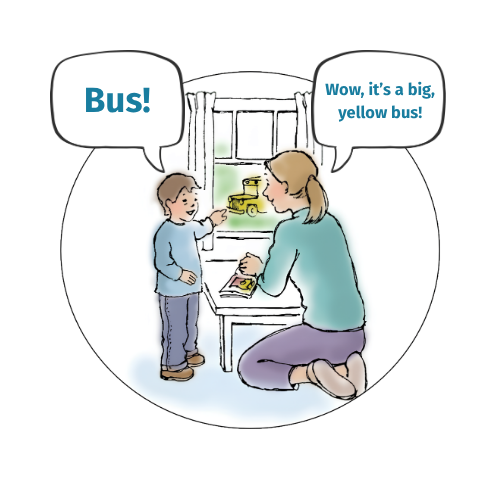 This child is very interested in vehicles, and he sees a bus outside. He looks at his mom, points and says, “Bus!” His mom stops focusing on the book they were looking at to respond to his interest and says, “Wow, it’s a big, yellow bus!” The child smiles and says, “Wheels”. His mom then says, “You want to sing ‘Wheels on the Bus’” and so they do. The interaction goes back and forth, and we can assume that the child is intrinsically motivated to communicate because:
- he chose what they’re communicating about
- he feels successful as a communicator because his mom responded to his messages
- the interaction is enjoyable, strengthening his connection to his mom
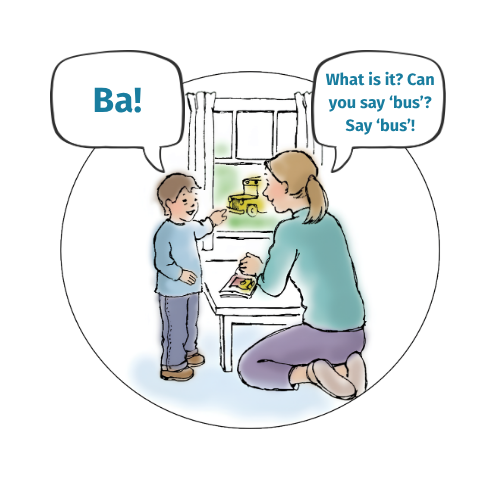 The child makes a sound and points excitedly at the bus outside the window. His mom tries to focus his attention back to the book and says, “Look it’s a train. Can you say ‘train’?” This requires the child to respond in a certain way. In this case, he is not intrinsically motivated to communicate because he has no control over what he communicates about. He may try to say “train” to get his Mom’s approval. However, because he didn’t have the opportunity to choose what they communicated about and doesn’t experience a feeling of success, he is not going to be as motivated to stay in the interaction.
- Use gestures, hold up objects, and point things out while you talk to your child. This helps them understand what words mean.
So how can you create interactions that feel motivating for your child? One of the best ways is by letting them lead so they feel that they have control over what they communicate about and can choose the topic.
Let your child lead
 Letting your child lead means giving them time and space to show you what interests them and what they want to communicate about. A great way to do this is by using a Hanen strategy called Observe, Wait and Listen™ (OWL™).
Start by getting face to face with your child. You might:
- lie on the floor across from them,
- sit face to face on the couch,
- pull up a chair across from them while they sit in their highchair.
Then, observe what catches your child’s attention. They might:
- look at a favourite toy
- reach for a book
- point at something outside
As you observe, wait quietly to give your child time to communicate. Your child may communicate using:
- facial expressions (like smiling)
- gestures (pointing, reaching or showing you something)
- sounds
- words
Listen carefully to what your child is trying to tell you.
When you Observe, Wait and Listen, you give your child the chance to start the interaction. And when your child gets to start the interaction and choose what you’re communicating about, they’re going to be more motivated to stay in the interaction and communicate with you.
Follow your child’s lead
Once your child starts the interaction, keep the conversation going by responding to what they said or did. When you respond warmly and enthusiastically to your child’s messages, they feel successful and connected to you. They learn that you understand their messages and are interested in what they want to share with you. This builds their confidence and sense of connection with you, which fuels their intrinsic motivation to continue the interaction.
You can follow your child’s lead by:
- Joining in and playing their way – for example, if your child is stacking blocks, join in and stack the blocks too
- Imitating – for example, if your child is making balls with playdough, make some of your own balls too
- Interpreting their message – for example, if your child points to a bird outside and makes a sound, you might say, “Wow, a bird is flying outside!”
- Making a comment – for example, if your child points to a dog in a book and says, “dog”, you could say, “That’s a big, furry dog”.
When communication feels enjoyable and meaningful to your child and when it makes them feel more connected to you, they are more motivated to interact – and those everyday moments are where the best language learning happens [1].

You can learn more about these strategies and many others that support your child’s communication in the It Takes Two to Talk® guidebook. Learn more at www.hanen.org/ITTTguidebook.
Similar articles by tag:
Social Communication | Language Development | Interaction | OWL | Follow Your Child’s Lead